
AppsFlyer cut Spark costs 50% without rewriting a job.
AppsFlyer brings in about 1 PB of new data every day. Its platform team had already cut infrastructure costs by moving to EMR Serverless. AppsFlyer reported 50% lower costs across its compaction jobs with Flarion.
“What surprised me was how fast it got to production. Bringing a new vendor into a data platform usually takes months. With Flarion, it was weeks.”
ADI BELANVP Engineering, Cloud, AI & Data, AppsFlyer
AppsFlyer’s platform was already optimized.
AppsFlyer moved from Hadoop to Kubernetes to EMR Serverless and had already right-sized resources for Spark. Further savings had to come from somewhere else.
Start with the hardest test.
AppsFlyer came to Flarion with its hardest workload. Compaction was its largest recurring workload: about 200 jobs, each running at least once a day and some every hour. Each sorted and shuffled recent data into larger Delta Lake files.
The platform team had already optimized the cluster settings and the compaction code, and didn’t think there was much left to save. Flarion still cut the costs by 50%.
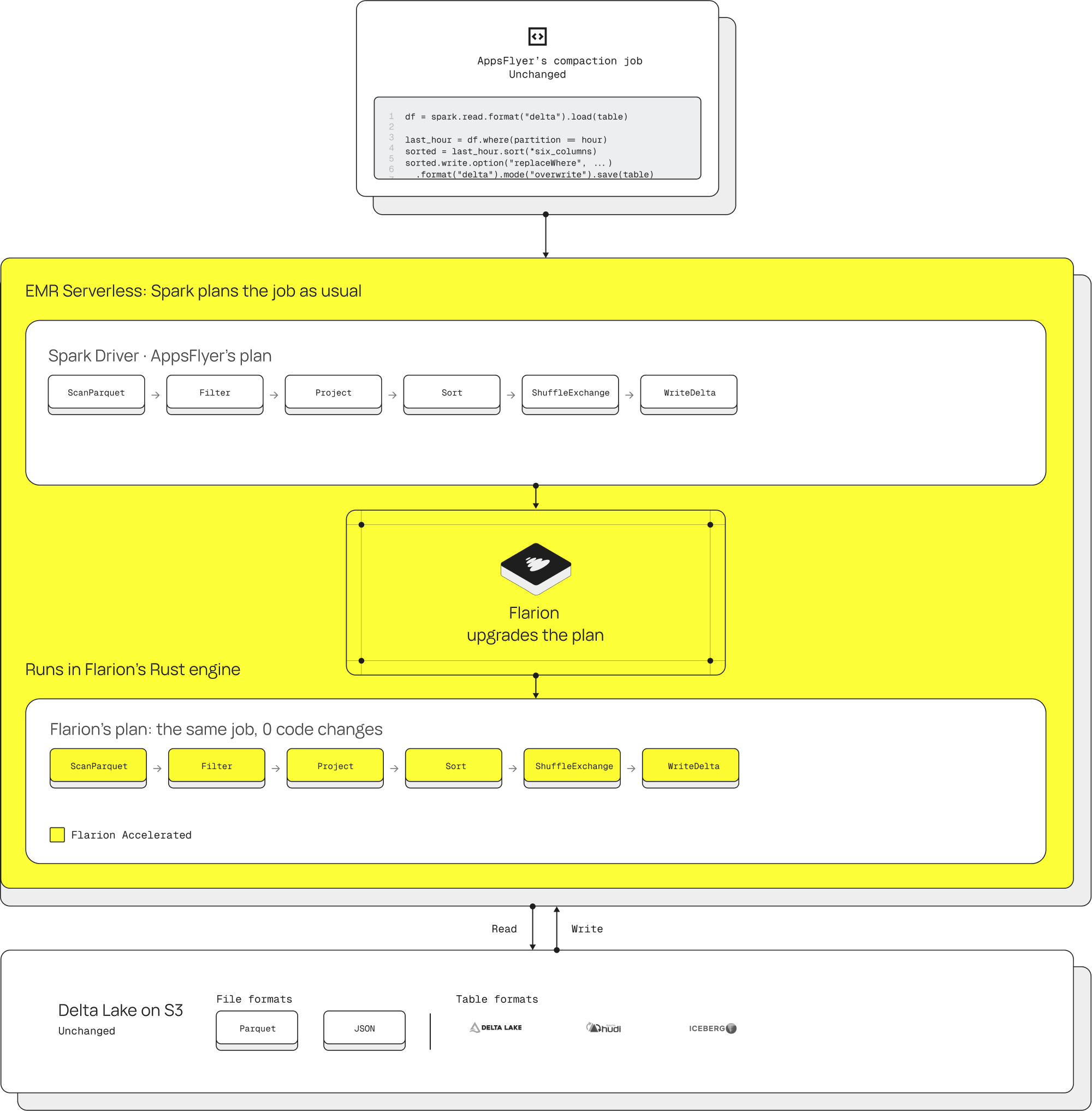
Lower costs, without a rewrite.
AppsFlyer did not want another integration project. Flarion offered a way to lower costs without rewriting the existing Spark jobs.
Flarion rebuilt the compaction workload in its lab from AppsFlyer’s query plans. On Flarion’s engine, it projected 40 to 50% lower cost. The next step was to prove that on AppsFlyer’s jobs.
Flarion changed the engine. AppsFlyer kept its code.
One senior platform engineer worked with Flarion from the first test runs through production. The team added the engine through the container image, Spark settings and Airflow template it already used.
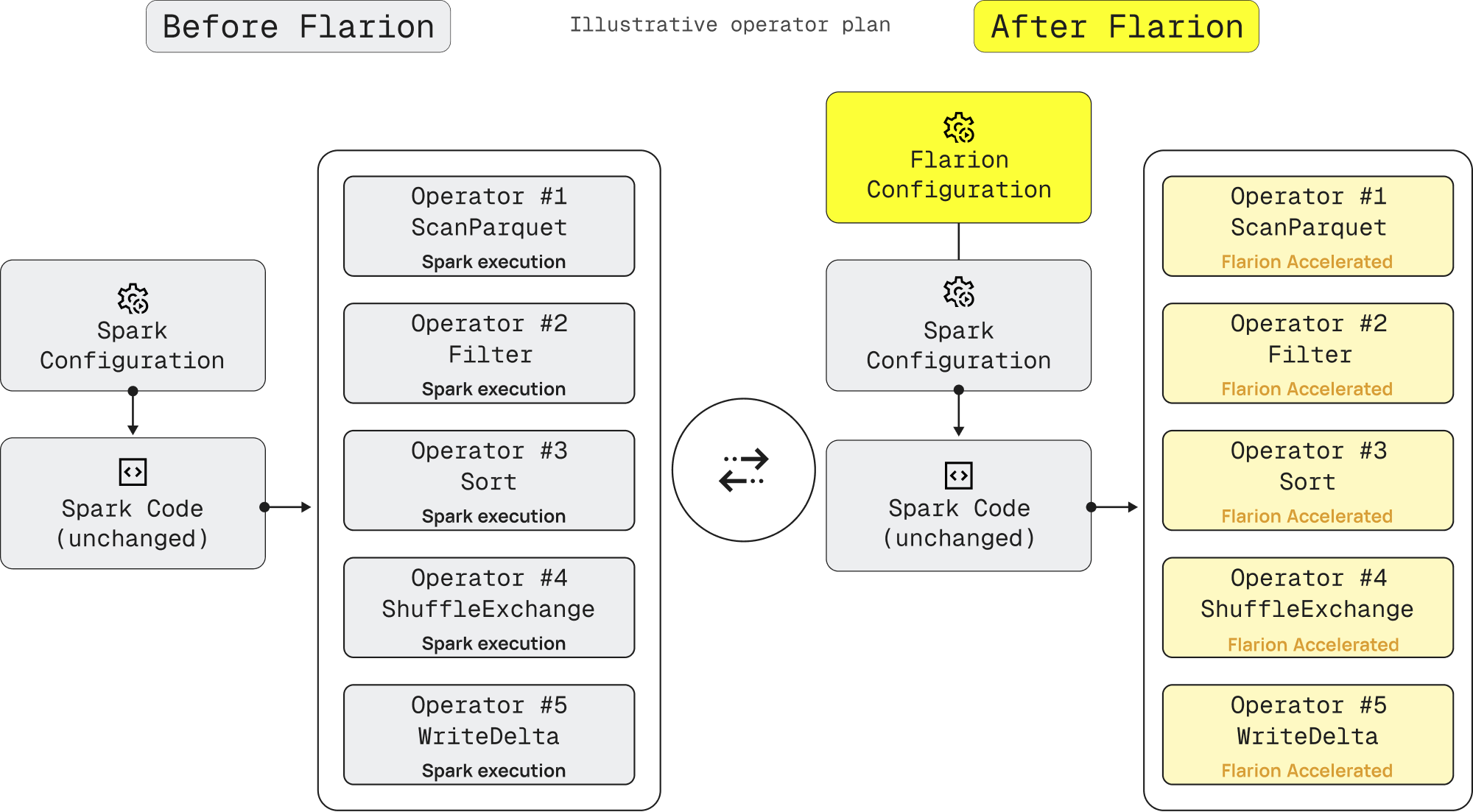
AppsFlyer added two JARs to its EMR Serverless image, Flarion’s engine and its Delta Lake integration, plus four lines of Spark configuration. The image passed the usual CI and security scan.
Flarion’s Rust engine ran every step of compaction: the read, the sort, the shuffle and the Delta write. AppsFlyer’s jobs ran as written, with no code changes.
Results on two test workloads matched Spark’s. Then all 200 compaction jobs moved to Flarion at once. Business data stayed in AppsFlyer’s AWS account. Flarion did not access it.
Compaction went first. Streaming followed.
An offline assessment of the compaction workload projected 40 to 50% lower cost.
The plugin set a baseline of runtime and cost for each workload.
All compaction jobs went into production with Flarion. Costs and run times fell from day one.
Kafka-to-S3 jobs followed with no lag or incidents. Flarion’s right-sizing guidance took the saving to 40 to 60%, depending on the workload.
Switch it off, and the cost comes back.
With Flarion, AppsFlyer’s compaction jobs cost 50% less. While upgrading to a newer EMR release, the team ran them without Flarion. Costs rose and failures came back.
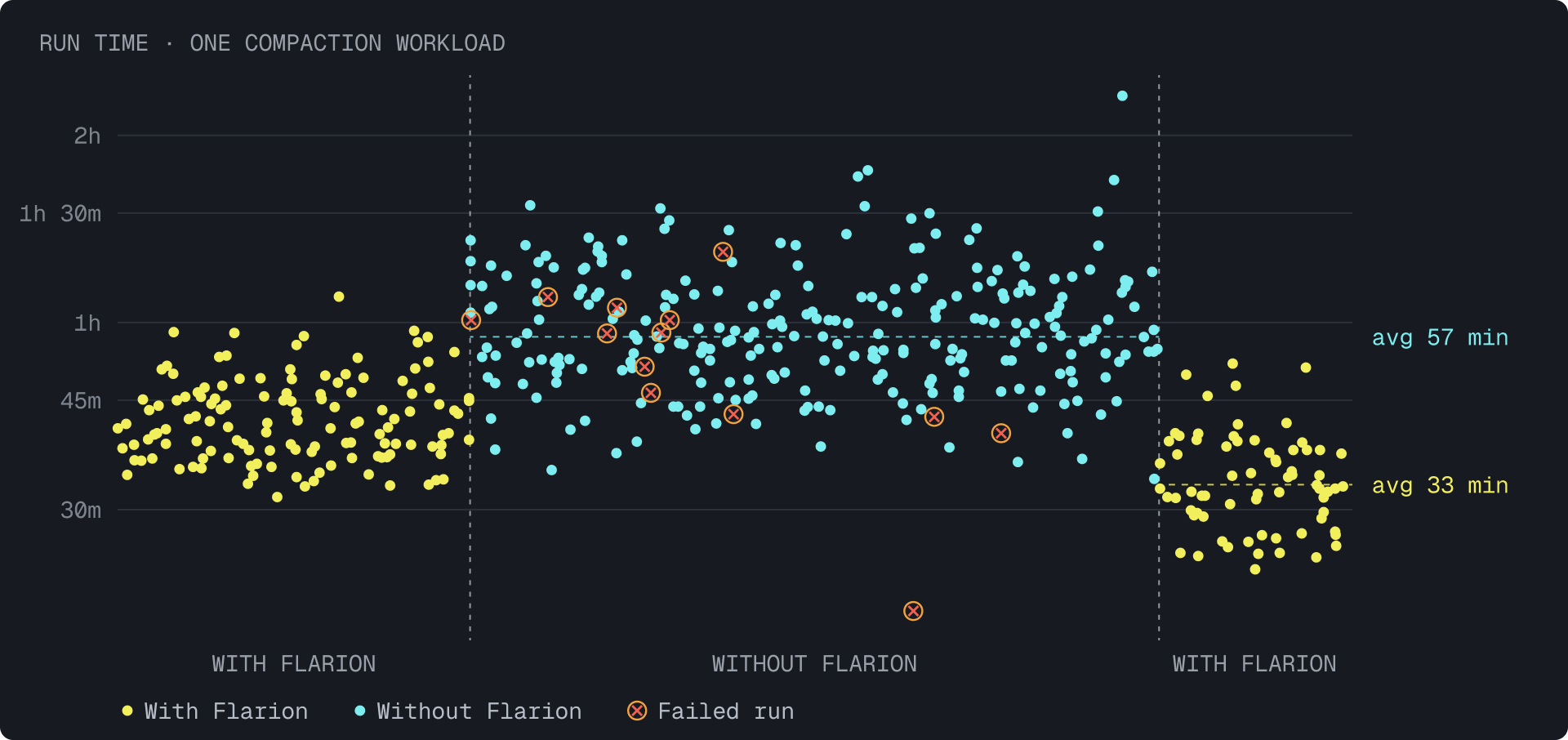
What the upgrade showed.
During the move to a newer EMR release, the team ran its compaction jobs without Flarion. Costs rose and runs started failing. When Flarion went back in, run times dropped and the failures stopped.
Faster and more reliable with Flarion.
The chart follows one of about 200 compaction jobs. With Flarion, it ran with no failures. Without Flarion, runs averaged 57 minutes and started to fail. With Flarion back, runs averaged 33 minutes with no failures.
The jobs cost less to run.
“No issues with Flarion. No lag or incidents during the switch…”
IVAN KOSIANENKO · STAFF ENGINEER, APPSFLYER
One senior platform engineer worked with Flarion from the first test runs through production, using the team’s existing image and job-submission process. Full rollout took weeks, and the savings started on day one: compaction cost less from its first production runs.
Compaction went first, all of its jobs at once. Kafka-to-S3 streaming followed. Both run in production with Flarion.
“More and more of our resources are going into AI, and AI depends on high-quality data. Making Spark faster and cheaper lets us put fewer resources into the data platform and more into AI.”
ADI BELAN · APPSFLYERVP Engineering, Cloud, AI & Data

Start with your Spark jobs.
Estimate the savings with an assessment, then validate the result on your own jobs.